
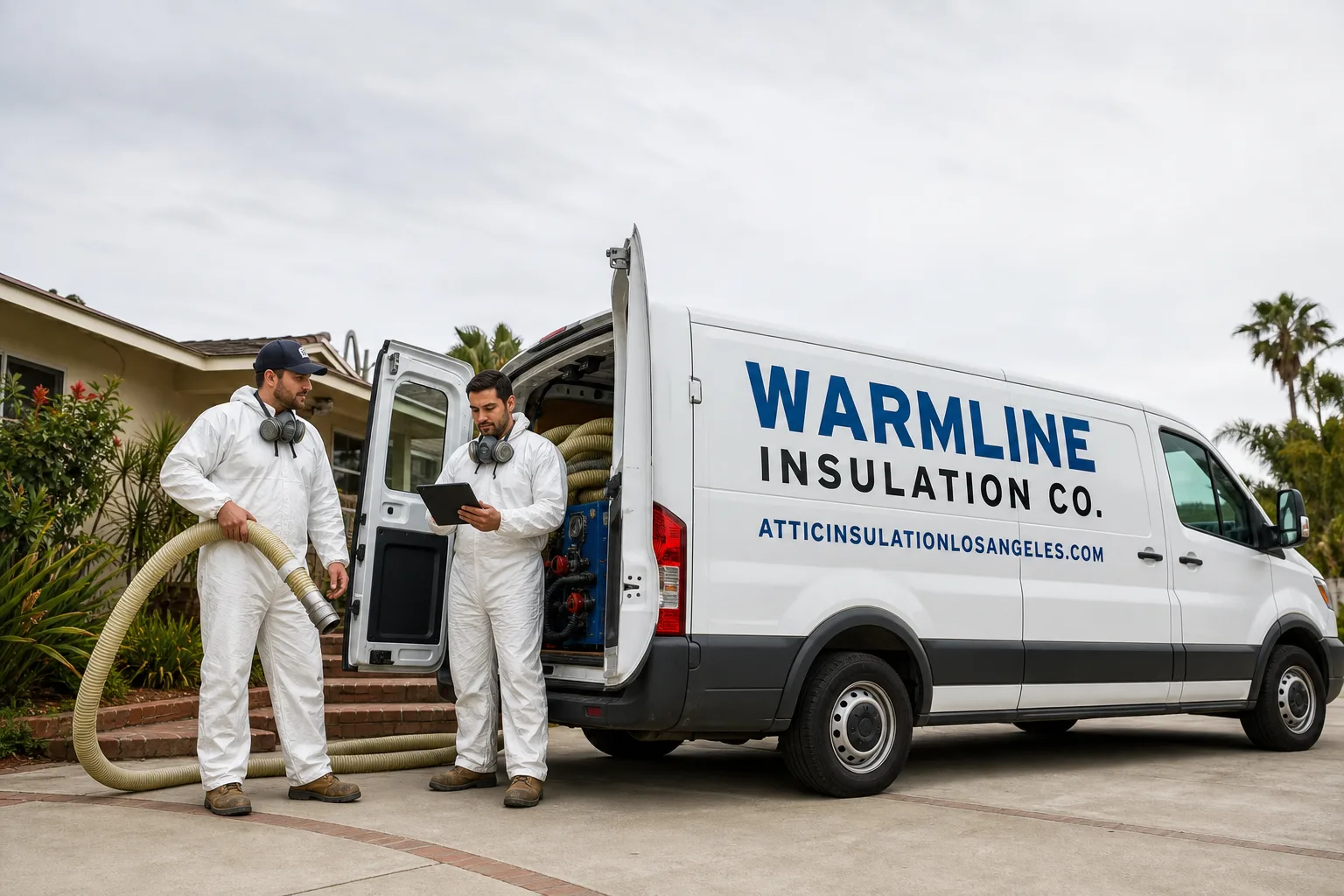
How Much Does Wall Insulation Cost in Los Angeles?
Our Wall Insulation services in Los Angeles typically cost between $1.50 and $4.50 per square foot, depending on the insulation type, wall access method, and the age of your home. For a 1,500-square-foot Los Angeles house with standard exterior walls, most homeowners budget $1,800 to $4,200 for a full project – though older bungalows in neighborhoods like Silver Lake or Boyle Heights often run higher due to irregular stud spacing and partial obstructions from previous work. Most jobs are completed in a single visit, and estimates from Warmline Insulation Co. are always free.
Wall Insulation Cost Breakdown (2026)
Here’s what Los Angeles homeowners are actually paying in 2026, broken down by insulation type and installation method. These ranges reflect real project costs in the LA market – labor, materials, and basic cleanup included.
| Insulation Type | Method | Cost Per Sq Ft | Typical Project Total (1,500 sq ft home) |
|---|---|---|---|
| Blown-In Fiberglass | Dense-pack (drill & fill) | $1.50 – $2.50 | $1,800 – $3,200 |
| Blown-In Cellulose | Dense-pack (drill & fill) | $1.75 – $2.75 | $2,000 – $3,500 |
| Batt Insulation (Open Wall) | Open-cavity (renovation or new build) | $1.00 – $2.00 | $1,200 – $2,800 |
| Open-Cell Spray Foam | Open-cavity or drill & fill | $2.50 – $3.75 | $3,000 – $4,800 |
| Closed-Cell Spray Foam | Open-cavity (renovation) | $3.50 – $5.50 | $4,200 – $7,000 |
| Rigid Foam Board | Interior retrofit | $2.00 – $3.50 | $2,400 – $4,500 |
| Mineral Wool (Rockwool) | Open-cavity (renovation) | $1.75 – $3.00 | $2,100 – $3,800 |
What These Numbers Actually Mean for Your Home
The ranges above assume standard 2×4 wood-framed exterior walls, which covers the majority of single-family homes built in Los Angeles before 1980. If your home has 2×6 framing – common in newer construction in Encino, Porter Ranch, or parts of the South Bay – cavity depth increases and so does material volume, pushing costs roughly 15-25% higher per wall section.
Drywall repair after a drill-and-fill job adds $150 to $600 depending on how many holes were made and whether you want a paint-ready finish or just a patched surface. Most Warmline projects include basic hole patching in the quoted price – ask about this when we give your estimate.
Interior walls between living spaces are less commonly insulated than exterior walls, but they matter a lot for noise reduction between bedrooms. Expect prices on the lower end of the blown-in range for those, since they’re typically accessible and unobstructed.
What Affects Wall Insulation Pricing in Los Angeles
LA is not a generic market. Several local factors push costs above or below the national averages you’ll see on other websites – and ignoring them leads to sticker shock at quote time.
- Wall access method: Existing homes with drywall in place require a drill-and-fill approach – small holes are bored into each stud bay, insulation is blown in under pressure, and holes are patched. This is more labor-intensive than open-cavity installation during a renovation, which is why retrofit projects cost more per square foot than new-construction work.
- Home age and construction type: Many homes in neighborhoods like Echo Park, Highland Park, and Leimert Park were built between 1910 and 1950, sometimes with non-standard stud spacing, diagonal bracing, or knob-and-tube wiring that complicates the drill-and-fill process. Our technicians do a thorough walkthrough before starting, specifically to catch these conditions.
- Los Angeles climate zone: Most of the LA basin sits in Climate Zone 9 under California’s Title 24 energy code, which specifies minimum R-values for walls. The required R-13 minimum for 2×4 walls shapes what products are viable and affects material selection. Coastal areas from Santa Monica through Malibu have naturally milder temperatures, which sometimes changes the cost-benefit math on insulation depth.
- Local labor rates: Los Angeles has some of the highest skilled-trade labor costs in the country. Expect to pay 20-35% more for the same scope of work here compared to the national averages published by generic home improvement sites. A figure that reads low on paper often doesn’t account for LA wage rates, traffic logistics, or permit-related delays.
- Permit requirements: LA County and the City of Los Angeles don’t require permits for most blown-in wall insulation retrofits, but adding spray foam to existing walls as part of a major renovation can trigger a building permit depending on the scope. If a permit is needed, add $200 to $500 for the permit fee and inspection scheduling. We handle the coordination.
- Existing insulation condition: Some homes we visit in the San Fernando Valley and on the Eastside already have deteriorated fiberglass batts from the 1970s sitting in the wall cavities. When that material has settled, gotten wet from prior plumbing leaks, or been compressed by rodents, it needs to be removed before new insulation goes in. Removal adds $0.50 to $1.00 per square foot to the project total.
- Number of stories and wall height: Two-story homes and properties with vaulted walls – more common in hillside neighborhoods like Glassell Park or the canyons above Studio City – require additional setup, sometimes scaffolding, and take longer per stud bay to fill properly. Single-story ranch-style homes are generally the most straightforward and least expensive to insulate.
Does Wall Insulation Actually Pay Off in Los Angeles?
This question comes up at almost every estimate we do, and it deserves a real answer rather than a vague “yes, you’ll save money.”
Los Angeles has a mild climate compared to the Northeast or Midwest, which means heating degree days are low and the payback period for wall insulation is longer than it would be in, say, Chicago. But the calculation changes when you factor in two things that are very specific to LA: cooling loads and electricity rates.
Southern California Edison and LADWP both operate tiered rate structures, and summer electricity costs have risen sharply since 2022. A home in the San Fernando Valley – where summer temperatures regularly hit 100°F or above – can run air conditioning for four to five months of the year. West-facing walls with no insulation absorb enormous heat loads in the afternoon hours, and that heat transfers directly into living spaces. Proper wall insulation with an R-value of R-13 to R-21 can meaningfully cut cooling loads, and in a hot-summer microclimate like Chatsworth, Reseda, or Sylmar, the energy savings on cooling alone often justify the project within four to seven years.
Beyond energy savings, wall insulation in Los Angeles also reduces outside noise – relevant if you’re near the 101, the 405, or Burbank Airport flight paths – and it creates a more stable indoor temperature from room to room, which is the complaint we hear most often from homeowners before they call us.
Insulation Types: Which One Is Right for Your Los Angeles Home?
Blown-In Fiberglass and Cellulose
These are the most common choices for retrofitting existing walls without opening the drywall. Knauf’s blown-in fiberglass and GreenFiber’s cellulose are two materials we use regularly at Warmline. Dense-pack cellulose achieves around R-3.7 per inch, which fills a 3.5-inch 2×4 cavity to roughly R-13 – exactly at California’s Title 24 minimum for Climate Zone 9. Blown-in fiberglass comes in slightly lower at R-2.2 to R-2.7 per inch but resists moisture better in walls that face coastal humidity from the marine layer.
In practice, cellulose is slightly more sustainable (it’s made from recycled paper) and is often the choice in homes where homeowners have asked about greener options. Fiberglass, particularly from Owens Corning and Johns Manville, is more widely available and performs well in the diverse microclimates across Los Angeles.
Spray Foam
Open-cell spray foam from Icynene or Demilec is sometimes used in open-cavity wall renovations where air sealing is as important as thermal resistance. It expands to fill every gap around outlets, pipes, and irregular framing – something blown-in insulation does well but not as completely. Closed-cell spray foam adds a vapor barrier effect, which is occasionally relevant in ground-level walls of homes in lower-lying areas of the LA basin near riverbeds or flood-prone zones.
Spray foam costs more, and for most standard Los Angeles wall retrofits, it’s not necessary. But if you’re doing a gut renovation or you have chronic moisture problems in specific walls, it’s worth discussing during your estimate.
Rockwool (Mineral Wool) Batts
Rockwool batts are our recommendation when walls are open during a renovation and fire resistance or soundproofing is a priority. They’re non-combustible, which matters in older neighborhoods where fire risk is a consideration – including hillside communities under the WUI (Wildland-Urban Interface) designation. CertainTeed also makes a competitive mineral wool product we spec on certain projects. Rockwool runs higher than fiberglass batts but stays in place better over time and doesn’t compress.
Batt Insulation (Fiberglass)
Owens Corning and Johns Manville fiberglass batts are the baseline choice for open-cavity installations during gut renovations. They’re the most cost-effective option per R-value when walls are already open, and they get the job done for most LA climate applications. The limitation is installation quality – batts that are compressed, torn, or fitted around obstructions lose effective R-value quickly. Our technicians are trained on proper batt fitting, which matters more than it sounds.
How to Save on Wall Insulation in Los Angeles
There’s real money to be saved if you approach a wall insulation project strategically. Here’s how.
- Bundle with attic insulation. The single most common way to reduce per-square-foot cost is to combine wall insulation with an attic project during the same visit. We mobilize once, use the same equipment, and can pass some of that efficiency on to you. If your attic insulation is also due for an upgrade – and in many pre-1980 LA homes, it is – bundling both services makes sense financially.
- Get a home energy audit first. A home energy audit identifies exactly which walls are losing the most heat and where air sealing needs to accompany insulation work. Spending $200 to $400 on an audit up front often saves you from insulating walls that don’t need it and focuses the project budget where it will actually change your energy bills.
- Apply for utility rebates. Both LADWP and SoCal Gas run rebate programs for residential insulation upgrades. Amounts vary by year and project scope, but $200 to $500 in rebates is realistic for a qualifying wall insulation project. We can advise you on what documentation to submit – ask about this during your estimate call.
- Use the 5% Senior and Veteran discount. Warmline offers a permanent 5% Senior and Veteran discount on all work. If you or a household member qualifies, mention it when you call – it applies to wall insulation projects of any size, no expiration date.
- Ask about the $50 off offer. Any repair or service over $250 qualifies for $50 off. Wall insulation projects nearly always exceed that threshold, so this offer almost always applies.
- Don’t delay if you’re already planning a renovation. The cheapest time to insulate a wall is when the drywall is already off for another reason – a bathroom remodel, a kitchen expansion, an electrical panel upgrade. Coordinating with your general contractor to have Warmline in during that window costs a fraction of a retrofit drill-and-fill job.
For a free estimate with upfront pricing and no pressure, call (213) 782-8141. A live person answers every call – no voicemail, no callback queue.
What the Installation Process Looks Like
A lot of homeowners hesitate on wall insulation because they imagine a messy, multi-day ordeal. For most Los Angeles homes, that’s not how it works.
For a standard drill-and-fill retrofit, our technicians start with a walkthrough of the exterior walls to map stud bays and identify any obstructions – fire blocks, pipes, previous insulation. We use a thermal camera on many jobs to confirm where cavities are truly empty before we drill. Small holes (roughly 2 inches in diameter) are bored at the top of each stud bay, dense-pack insulation is blown in under controlled pressure until the cavity is full and settled, and holes are patched with a pre-mixed compound. The patch dries to a paintable finish.
For a typical 1,200-1,800 square foot single-story home, this work is done in one day. Most jobs are completed in a single visit, which means you’re not scheduling a second crew to come back and finish.
If drywall finish-coat or painting is needed beyond basic patching, we’ll tell you that upfront so you can plan accordingly – we don’t surprise you with it after the fact.
Comparing Warmline to Other Los Angeles Insulation Contractors
Warmline Insulation Co. has been doing this work since 2011 – over 15 years serving Los Angeles homeowners. That track record matters for a few specific reasons.
First, insulation is a specialty. Generalist contractors who occasionally do insulation work don’t have the same material knowledge, equipment calibration experience, or familiarity with LA-specific construction quirks. We work with Owens Corning, Rockwool, CertainTeed, Icynene, Demilec, Johns Manville, Knauf, and GreenFiber – the manufacturers who set the standards in this industry – because using proven materials is part of how we back the 90-Day Done Right Promise.
Second, all ten of our service categories live under one roof. If your wall insulation estimate reveals that the attic needs air sealing too, or that a crawl space vapor barrier would complete the envelope, we handle that without sending you to find another contractor. That matters in Los Angeles, where coordinating multiple trades can add weeks to a project timeline.
Third, Neil Ashford leads our team with a building-science approach to every job. That means we’re thinking about your home as a system – not just filling a cavity because you asked us to. If there’s a better solution for your specific situation, Neil will tell you.
Every technician we send is background-checked and arrives in uniform. Pricing is given upfront before any work starts. And if something isn’t right after we leave, the 90-Day Done Right Promise means we come back and fix it – in writing, not just a verbal assurance.
Los Angeles Neighborhoods We Serve
Warmline serves homeowners throughout the greater Los Angeles area. We regularly work in Silver Lake, Echo Park, Highland Park, Boyle Heights, the San Fernando Valley (including Encino, Sherman Oaks, Reseda, Chatsworth, and Sylmar), the South Bay, the Eastside, Mid-City, Culver City, and hillside communities from Glassell Park to Studio City. If you’re in the LA basin and wondering whether we cover your neighborhood, call us – the answer is almost certainly yes.
For a full overview of our Wall Insulation in Los Angeles services, including what we do, what products we use, and how the process works from start to finish, that page has the detail you need before calling.
FAQs – Wall Insulation Cost in Los Angeles
How much does it cost to insulate walls in an existing Los Angeles home?
In Los Angeles, retrofitting existing walls with blown-in insulation costs $1.50 to $2.75 per square foot, including labor, materials, and basic hole patching. For a typical 1,400 square foot single-story home, that works out to $1,800 to $3,200 for most projects. Spray foam and mineral wool cost more and are generally reserved for open-wall renovations. Call (213) 782-8141 for an exact quote – estimates are free and come with upfront pricing before any work begins.
Is wall insulation worth it in Los Angeles given the mild climate?
Yes, especially if you’re in a hot-summer microclimate like the San Fernando Valley, where cooling costs drive energy bills from May through October. The payback period for wall insulation in Los Angeles runs four to eight years depending on your home’s current condition, your utility provider, and how much of the home you’re insulating. Homes near the 101, 405, or airport flight paths also see meaningful noise reduction – a benefit that doesn’t show up in an energy audit but matters day to day. Call (213) 782-8141 to talk through whether the project math works for your specific home.
Do I need a permit to insulate walls in Los Angeles?
For most wall insulation retrofits in the City of Los Angeles – specifically blown-in insulation through drill-and-fill – no permit is required. If the project is part of a major renovation that includes structural or electrical work, a permit may be needed depending on the overall scope. LA County unincorporated areas follow similar rules. We handle the permit coordination if one is needed; the fee typically runs $200 to $500. We’ll tell you upfront whether your project requires one.
How long does wall insulation installation take in a Los Angeles home?
For a single-story home with standard wood-frame walls, a full drill-and-fill installation is typically complete in one day. A 1,200 to 1,800 square foot home usually takes four to eight hours, including setup, installation, and hole patching. Two-story homes or properties with complicated access – hillside lots, partial block construction, or previous retrofit complications – can run into a second day, but most jobs are completed in a single visit. We’ll give you a realistic time estimate before we start.
What is the cheapest way to insulate walls in an existing home?
The least expensive method for existing walls is blown-in fiberglass or cellulose dense-pack, which runs $1.50 to $2.50 per square foot in the LA market. The cheapest time to insulate any wall is when drywall is already removed for a renovation – open-cavity batt installation costs $1.00 to $2.00 per square foot and avoids drilling and patching entirely. If budget is a constraint, a home energy audit first helps identify which walls to prioritize so you’re spending where it will make the most difference. Call (213) 782-8141 for a free estimate.
Can Warmline insulate just one wall, or does the whole house need to be done at once?
We can absolutely insulate a single wall, a single room, or a specific elevation – there’s no minimum project size. Homeowners in Los Angeles often start with the west-facing walls (highest afternoon heat load) or the walls adjacent to an attached garage before tackling the full exterior. A partial project runs proportionally to the square footage involved, using the same per-square-foot pricing as a full-home job. We’ll give you a clear line-item quote so you can decide how much to tackle now.
Pricing reflects the Los Angeles market as of 2026. Warmline Insulation Co. offers free estimates – call (213) 782-8141.
Written by Neil Ashford, Owner at Warmline Insulation Co., serving Los Angeles since 2011.
What Our Customers Say
"The estimate had every line itemized - removal, sealing, baffles, the blown-in by the bag - and the final invoice matched it exactly. Two other companies quoted a single number and could not tell me what R-value they were installing."
- Priya Raman"They did the energy audit first - blower door and thermal camera - and showed me exactly where the house was leaking before selling me anything. The fix ended up being air sealing plus a modest attic top-up, not the full replacement another company pushed."
- Grace Nakamura"Solid work on the spray foam in the rim joists and the garage ceiling. Scheduling slipped a day because of rain, which they called about ahead of time. Would use them again."
- Tom Reinholt