
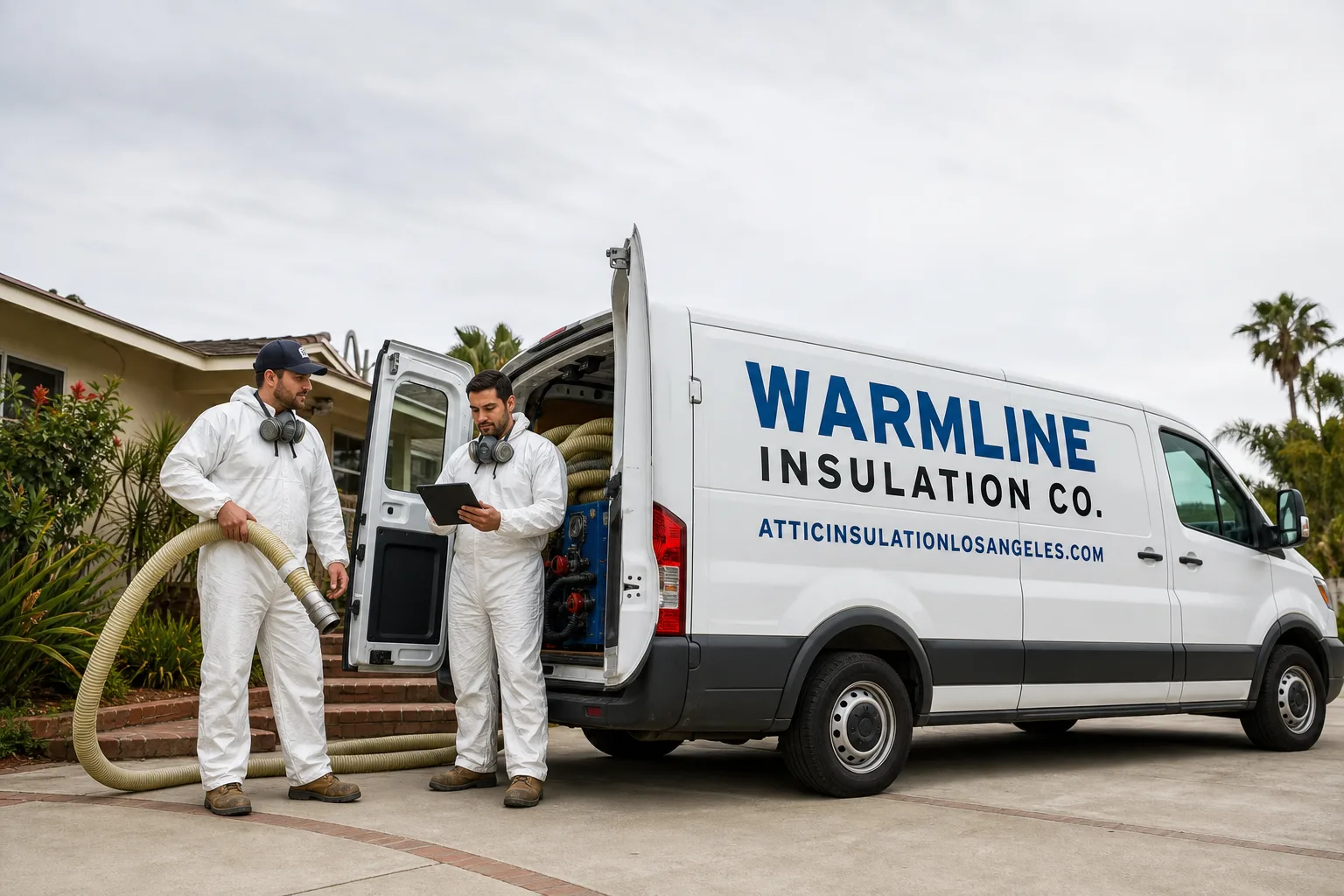
How Much Does Attic Air Sealing Cost in Los Angeles?
Attic air sealing in Los Angeles typically costs between $1,500 and $4,500 for a standard single-family home, with most homeowners paying around $2,200 to $3,000 when the attic is accessible and in good condition. The price varies based on attic size, the number of penetrations that need sealing, and whether insulation needs to be temporarily moved to access the framing below.
At Warmline Insulation Co., we’ve been sealing Los Angeles attics since 2011 – and in that time, we’ve learned that this market has a few pricing quirks you won’t find in national averages. Here’s the full breakdown, neighborhood context and all.
Attic Air Sealing Cost Breakdown (2026)
Attic air sealing in Los Angeles costs $1,500 to $4,500 for most homes. The table below reflects what we actually see on the ground across LA County – from compact Koreatown bungalows to sprawling San Fernando Valley ranch houses.
| Scope of Work | Typical Price Range (LA Market) |
|---|---|
| Small home or condo attic (under 1,000 sq ft floor area) | $1,500 – $2,000 |
| Mid-size home (1,000 – 2,000 sq ft) | $2,000 – $3,000 |
| Larger home (2,000 – 3,000 sq ft) | $2,800 – $4,000 |
| Large or complex attic (3,000+ sq ft, multiple HVAC systems) | $3,800 – $4,500+ |
| Air sealing only (no insulation work, existing insulation intact) | $1,200 – $2,200 |
| Air sealing + blown-in insulation top-up | $2,500 – $4,800 |
| Air sealing + full insulation removal and replacement | $4,500 – $9,000 |
| Attic hatch sealing only (standalone) | $150 – $350 |
| Spray foam sealing at top plates and rim joists | $600 – $1,400 (add-on) |
| Blower door test (pre/post verification) | $250 – $500 |
A few things drive these numbers in Los Angeles specifically. Older homes – and LA has a lot of them, particularly in neighborhoods like Silver Lake, Highland Park, and Echo Park where much of the housing stock dates to the 1940s and 1950s – tend to have more penetrations through the top plate: old knob-and-tube electrical runs, abandoned plumbing vents, and rough cuts that were never air-sealed because nobody thought to do it back then. More penetrations means more labor, which moves the price toward the upper end of the range even on a modestly sized home.
On the other end, newer construction in areas like Playa Vista or the mid-2000s developments in Chatsworth often has cleaner framing with fewer bypasses, which can bring a job in toward the lower end. Attic accessibility also matters: low-pitch roofs common in many mid-century LA homes sometimes require more careful maneuvering, which adds time.
If your existing insulation is blown-in cellulose or fiberglass, it usually needs to be pulled back from the top plates before sealing and then redistributed afterward. That labor adds $300 to $700 to the job depending on depth and coverage. We include that in our upfront quote so there are no surprises on the day.
What Affects Attic Air Sealing Pricing in Los Angeles
- Home size and attic floor area: The single biggest driver. Larger attics have more linear feet of top plate, more penetrations for lights and pipes, and more ground to cover. A 1,200 sq ft Silver Lake bungalow and a 2,800 sq ft Northridge ranch house are two very different jobs, even if both just need air sealing.
- Number and type of penetrations: Every can light, electrical chase, plumbing vent, HVAC boot, and wall cavity opening is a potential bypass. Older Los Angeles homes frequently have dozens of unsealed can lights recessed into the ceiling – these are among the worst air leaks we find anywhere in the region. Sealing each one correctly takes time and the right material: typically a fire-rated cover and foam, not just caulk.
- Existing insulation depth and condition: If insulation sits directly over the areas that need sealing, it has to be temporarily moved. Wet, contaminated, or rodent-damaged insulation may need to come out entirely before we can seal – and that shifts the project into removal-and-replacement territory. In the San Fernando Valley and parts of the Eastside, we regularly find attic insulation that hasn’t been touched since the 1970s, and it’s often more cost-effective to replace it than work around it.
- Attic access and working conditions: A floored, walk-in attic with good head clearance is straightforward. A low-pitch attic with only a 20-inch hatch, no flooring, and 140-degree summer heat (standard for south-facing LA roofs in July) takes longer and costs more because it simply takes more effort to complete safely and correctly. LA’s climate creates working conditions that slow jobs down in ways that a Phoenix or Seattle cost estimate wouldn’t account for.
- HVAC duct configuration: Many Los Angeles homes have ductwork running through unconditioned attic space. Leaky ducts compound the air sealing problem significantly. If we find major duct leakage during sealing, we’ll flag it – and duct sealing is often worth addressing at the same time to maximize efficiency gains. Adding duct sealing typically runs $800 to $2,000 depending on the system size and condition.
- Whether a blower door test is included: A pre- and post-sealing blower door test proves the work actually reduced air infiltration. Some contractors skip this; we think it’s worth doing because it tells you exactly how much you’ve improved your home’s airtightness. In the Los Angeles market, a blower door test adds $250 to $500 to the project, and it’s the only objective way to verify results. If you’re applying for any utility rebate through SoCalGas or LADWP, you may need this data anyway.
Los Angeles-Specific Factors That Change the Math
National pricing guides don’t account for what makes Los Angeles homes different, so we’ll be direct about it.
A significant portion of Los Angeles housing was built between 1920 and 1970 – that’s true in neighborhoods from Boyle Heights to Reseda to Westchester. These homes were built before energy codes required any air sealing whatsoever. Many have been through partial renovations that added new can lights or HVAC equipment without closing the old bypasses. When we do a blower door test on a 1950s LA home that’s never been sealed, we frequently measure 8 to 15 air changes per hour – roughly two to four times what modern code requires. The more leaky the starting point, the more material and labor the job needs.
LA’s climate also shapes what kind of sealing is most important. Unlike homes in colder climates where stack effect drives hot air out through the attic all winter, Los Angeles homes lose conditioned air in summer primarily through a combination of radiant heat gain and pressure differentials created by HVAC systems. That means sealing around HVAC boots and return air plenums is especially high-value here – it keeps your air conditioning where it belongs rather than letting it bleed into an attic that’s sitting at 130 or 140 degrees on a July afternoon in Van Nuys or Canoga Park.
Finally, Los Angeles permit requirements: standalone attic air sealing typically doesn’t require a building permit in most LA jurisdictions. However, if the work is part of a larger insulation replacement or involves fire-rated assemblies, your contractor should know the local rules. We handle that review as part of our pre-job process.
How to Save on Attic Air Sealing in Los Angeles
There are a few legitimate ways to lower your out-of-pocket cost without cutting corners on the work itself.
Stack the project with insulation work. If your attic insulation is already due for replacement or a top-up, doing both in a single visit saves money on mobilization and labor. Moving insulation, sealing, and re-installing in one job is more efficient than two separate visits. Most of our Attic Air Sealing services are completed in a single day, and when we’re already up there, it makes sense to address everything at once.
Check for LADWP and SoCalGas rebates. Both utilities offer rebate programs for home energy improvements, and attic air sealing often qualifies – particularly when paired with insulation upgrades. The rebate amounts change periodically, but they’ve historically ranged from $150 to $500 for qualifying air sealing work. Your contractor needs to be approved by the utility to process these; Warmline Insulation Co. can walk you through what’s currently available when we come out for your estimate.
Ask about the federal energy efficiency tax credit. Under current federal tax code, homeowners may claim a credit of up to 30% of the cost of qualifying air sealing and insulation work (up to the annual cap). Talk to your tax advisor about eligibility – this isn’t a rebate that comes off the contractor invoice, but it can materially reduce your net cost when you file.
Take advantage of Warmline’s standing discounts. If your total project qualifies, our $50 Off Any Repair Over $250 applies. Active and retired military and seniors receive a permanent 5% Senior and Veteran discount on every job – no paperwork hoops, just mention it when you call. And if your attic needs a seasonal check-up before committing to a larger project, our $89 Seasonal Tune-Up is a practical starting point.
Get an estimate before anything else. A proper attic assessment changes the equation. Some attics that look large on paper have simple bypass configurations that come in well under the average; others that look small are nightmares of old can lights and abandoned chases. The only way to know is to have someone who knows what they’re looking at actually get up there. Our estimates are free, and a live person picks up when you call (213) 782-8141 – no voicemail, no callback queue.
Consider a home energy audit as a starting point. If you’re not sure whether air sealing is the right first investment, a home energy audit gives you a ranked list of what’s costing you the most. Sometimes air sealing is the clear winner; sometimes duct sealing or insulation depth is the bigger issue. Knowing that before you spend money means every dollar goes toward the fix that actually moves the needle on your energy bills.
What You Get for That Price: The Warmline Process
It’s worth explaining what a professional air sealing job actually includes, because “attic air sealing” is one of those service descriptions that can mean very different things depending on who’s doing it.
When Neil Ashford’s crew at Warmline Insulation Co. seals an attic in Los Angeles, the job starts with a walkthrough – attic hatch, visible framing, penetration inventory, and a check of existing insulation condition. If we’re doing a blower door test, we run it before we touch anything to establish a baseline. Then we seal: top plates get two-part closed-cell spray foam (Icynene and Demilec are two of the brands we use, depending on application); can lights get fire-rated covers and foam; plumbing and electrical penetrations get appropriate caulk or foam depending on diameter; attic hatches get weatherstripping and, where warranted, a rigid insulation cover. We don’t skip the hatch – it’s one of the worst air leaks in most LA homes and one of the easiest to fix properly.
After sealing, existing insulation is redistributed or new blown-in material (Owens Corning, Johns Manville, GreenFiber, or Knauf, depending on spec) is installed to the correct depth for LA’s climate zone. If we ran a pre-test, we run the post-test to confirm results. The whole job is typically done in a single visit, and every job is backed by our 90-Day Done Right Promise: if the work isn’t right, we make it right. That’s in writing.
Neil has been building this company around that standard since 2011. Background-checked, uniformed technicians show up on time, do the work correctly, and leave the attic cleaner than they found it. That’s not a marketing claim – it’s how we’ve kept Los Angeles homeowners calling us back for over 15 years.
FAQs: Attic Air Sealing Cost in Los Angeles
How much does attic air sealing cost in Los Angeles in 2026?
Attic air sealing in Los Angeles costs $1,500 to $4,500 for most single-family homes, with the most common range landing between $2,000 and $3,000. Smaller homes or condos with accessible attics can come in below $2,000; larger homes with complex framing, many can lights, or old insulation that needs to be moved will push toward the upper end. Call (213) 782-8141 for a free estimate – we’ll give you a specific number based on your actual attic, not a generic range.
Is attic air sealing worth it in a Los Angeles climate?
Yes – and in some ways it’s more impactful here than in colder markets. In Los Angeles, a leaky attic lets 130+ degree summer air interact directly with your HVAC system and conditioned living space, which forces your air conditioning to work far harder than it should. Most LA homeowners who air seal a previously unsealed attic see 15% to 30% reductions in cooling costs, with payback periods of 3 to 6 years at current energy rates. Homes in the Valley (Encino, Sherman Oaks, Granada Hills) and inland areas that deal with hotter summers tend to see the strongest returns. The work also improves comfort significantly in rooms that are directly under the attic – a common complaint in LA’s single-story ranch houses.
Can attic air sealing and insulation be done in the same visit?
Yes, and we recommend it. Doing both in a single visit is more efficient – the attic is already prepped and the crew is already there, so you avoid paying for a second mobilization. Most combined air sealing and insulation projects at Warmline Insulation Co. are completed in a single day. If your insulation is in decent shape and just needs to be temporarily moved, the add-on cost is relatively modest ($300 to $700 in most cases). If it needs full replacement, we’ll tell you that upfront with a clear price before any work starts.
Does attic air sealing require a permit in Los Angeles?
Standalone attic air sealing typically does not require a building permit in most Los Angeles jurisdictions, including the City of LA and most incorporated cities in LA County. However, if the project involves changes to fire-rated assemblies or is combined with work that does trigger permit requirements (like certain HVAC modifications), the rules shift. We review permit requirements as part of every project assessment – if a permit is needed, we’ll handle that process rather than leaving it to you.
How long does attic air sealing last?
Done correctly with professional-grade materials, attic air sealing lasts 20 to 30 years or more. Spray foam seals like Icynene or Demilec don’t shrink, crack, or degrade under normal attic conditions. The products we use from Owens Corning, Rockwool, and CertainTeed are designed for long-term performance – and every job is backed by our 90-Day Done Right Promise. The main reason attic air sealing “fails” prematurely is that it was done incompletely in the first place, skipping penetrations or using the wrong material for the application. A blower door test after the work is the best way to verify nothing was missed. Call (213) 782-8141 to discuss what materials and approach make sense for your home.
What’s the difference between air sealing and insulation – do I need both?
They do different things. Insulation resists heat transfer (conduction); air sealing stops air movement (convection and infiltration). In most Los Angeles attics built before 1990, both are underperforming. You can pile R-60 of insulation on top of an unsealed attic and still have high energy bills, because the air moving through gaps around can lights and top plates bypasses the insulation entirely. The two work best together. That said, if budget is a constraint, air sealing first tends to give you better return per dollar in LA’s climate than adding insulation depth alone. We’ll give you honest advice on prioritization when we assess your attic – no pressure to do more than what makes sense for your situation.
Key Takeaways
- Attic air sealing in Los Angeles costs $1,500 to $4,500 for most homes; the most common range is $2,000 to $3,000.
- Older LA homes (pre-1970) in neighborhoods like Silver Lake, Highland Park, and the mid-Valley typically have more penetrations and unsealed bypasses, pushing costs toward the higher end.
- LA’s summer climate – with attic temperatures regularly exceeding 130 degrees – makes air sealing especially high-value for cooling cost reduction.
- Combining air sealing with insulation work in a single visit saves on labor and mobilization costs.
- LADWP, SoCalGas, and federal tax credits can meaningfully reduce net cost – ask about current eligibility when you call.
- Warmline Insulation Co. offers free estimates, upfront pricing, and a 90-Day Done Right Promise on every job.
- Seniors and veterans receive a permanent 5% discount; jobs over $250 qualify for $50 off.
- A blower door test ($250 to $500) is the only objective way to verify results and may be required for utility rebate applications.
Ready to Find Out What Your Attic Needs?
If you’re spending more on cooling than you think you should, or if certain rooms in your Los Angeles home never seem to reach a comfortable temperature, your attic is usually the first place to look. Neil Ashford and the team at Warmline Insulation Co. have been diagnosing and fixing exactly this problem across Los Angeles County since 2011.
We send background-checked, uniformed technicians, give you a specific price before any work starts, and back every job with our 90-Day Done Right Promise. A live person answers when you call – not a voicemail, not an answering service. Call (213) 782-8141 today for your free attic assessment and estimate. Most jobs are completed in a single visit, and we’d rather give you a real number than a vague range.
Pricing reflects the Los Angeles market as of 2026. Written by Neil Ashford, Owner at Warmline Insulation Co., serving Los Angeles since 2011. Warmline Insulation Co. offers free estimates – call (213) 782-8141.
What Our Customers Say
"Crawl space smelled musty and the floors were cold. Full encapsulation with the thick liner taped at every seam, and a dehumidifier sized for the space. The hygrometer they left reads 48 percent now instead of the 70s."
- Elena Vasquez"The estimate had every line itemized - removal, sealing, baffles, the blown-in by the bag - and the final invoice matched it exactly. Two other companies quoted a single number and could not tell me what R-value they were installing."
- Priya Raman"They did the energy audit first - blower door and thermal camera - and showed me exactly where the house was leaking before selling me anything. The fix ended up being air sealing plus a modest attic top-up, not the full replacement another company pushed."
- Grace Nakamura